


Last Updated: November 14, 2026
Quick Summary
Palatability reviews show whether a dog will eat a joint supplement, but they rarely prove it works. A reliable review states how many dogs were tested, the format offered, and whether the reviewer had a conflict of interest. Judge taste and efficacy as two separate claims.
- A reliable palatability review states how many dogs were tested and how the product was offered.
- A favourite label alone says little without the sample size and testing method.
- Taste and health benefits are separate claims and need separate evidence.
- Check whether the reviewer received free product or earns affiliate commission.
- Keep a daily note of how readily your dog eats the supplement over at least a month.
Table of Contents
- What Palatability Reviews Actually Measure
- Why Palatability Matters as Much as Ingredients
- Powder vs Chews: Which Format Dogs Accept More Readily
- Reading the Ingredients Behind the Taste
- How to Give a Dog Joint Supplement Without a Fight
- How to Judge a Palatability Review Before You Trust It
- Choosing a Format Your Dog Will Actually Eat
- Frequently Asked Questions
What Palatability Reviews Actually Measure
Palatability reviews try to answer a simple question: will your dog eat the supplement? That matters, because a joint supplement only works if it is given every day. Many reviews, however, mix taste with other things, such as whether the owner saw an improvement or whether the ingredients look impressive on paper. Winston & Porter believes these should be judged separately.
A reliable palatability review should state how many dogs were tested, how the product was offered, and whether the dog ate it willingly or needed it hidden in food. Without that detail, a "favourite" label tells you little. The UK-focused review of ten dog joint supplements reports a palatability test, but the published result does not name a score or the testing method in enough detail to repeat.
Efficacy is a separate question. A 2022 study in dogs with osteoarthritis concluded that its tested product helped reduce pain and clinical signs, but that finding concerns one product, not every supplement on the shelf. Treat palatability and efficacy as two separate claims that need two separate sources.
Why Palatability Matters as Much as Ingredients
A supplement with excellent ingredients does nothing if the dog refuses it. Owners who struggle to get a powder into their dog's bowl often give up after a few days, and joint support depends on daily consistency.
Owner-reported refusal is one of the most common frustrations with these products. A 2022 study on joint supplement use in adult dogs found that 40% of the adult dogs in its population received some form of joint supplement, which shows how many owners are trying these products. The same study does not tell us how many of those dogs kept taking them, so palatability remains an open question for most households.
At Winston & Porter, we formulate our joint supplements to be easy to mix into everyday food. We think that practical choice matters as much as the ingredient list, because a supplement only helps the dogs who actually eat it.
Powder vs Chews: Which Format Dogs Accept More Readily
Format changes how a supplement is given, and it changes what 'acceptance' actually means. A powder mixed into food is accepted if the dog finishes the bowl; a chew is accepted only if the dog takes it plain or with minimal masking. Comparing the two without separating those conditions is where most reviews fall down.
A workable head-to-head comparison uses the same criteria for every format:
- Plain acceptance: does the dog take it from the hand or bowl with no food mixed in?
- Mixed acceptance: does the dog finish a normal meal when the product is stirred through?
- Refusal pattern: is refusal immediate, after a few days, or after a few weeks?
- Effort per serving: how much preparation does the owner do each day?
- Long-term adherence: is the dog still taking it after a month?
On those criteria, powders and chews fail in different ways. Powders depend on the dog finishing the bowl, so a dog that eats slowly, leaves the bottom of the bowl, or is fed separately may take in less than the full serving. Chews depend on the dog accepting a separate item, so a dog that is fussy about texture or flavour may refuse outright. Liquids sit between the two: easy to syringe or mix, but some dogs dislike the smell.
Reviews that claim a clear winner without stating their sample size, trial duration and refusal rate should be read as opinion rather than testing, which is why trying one format before concluding the supplement 'doesn't work' matters.
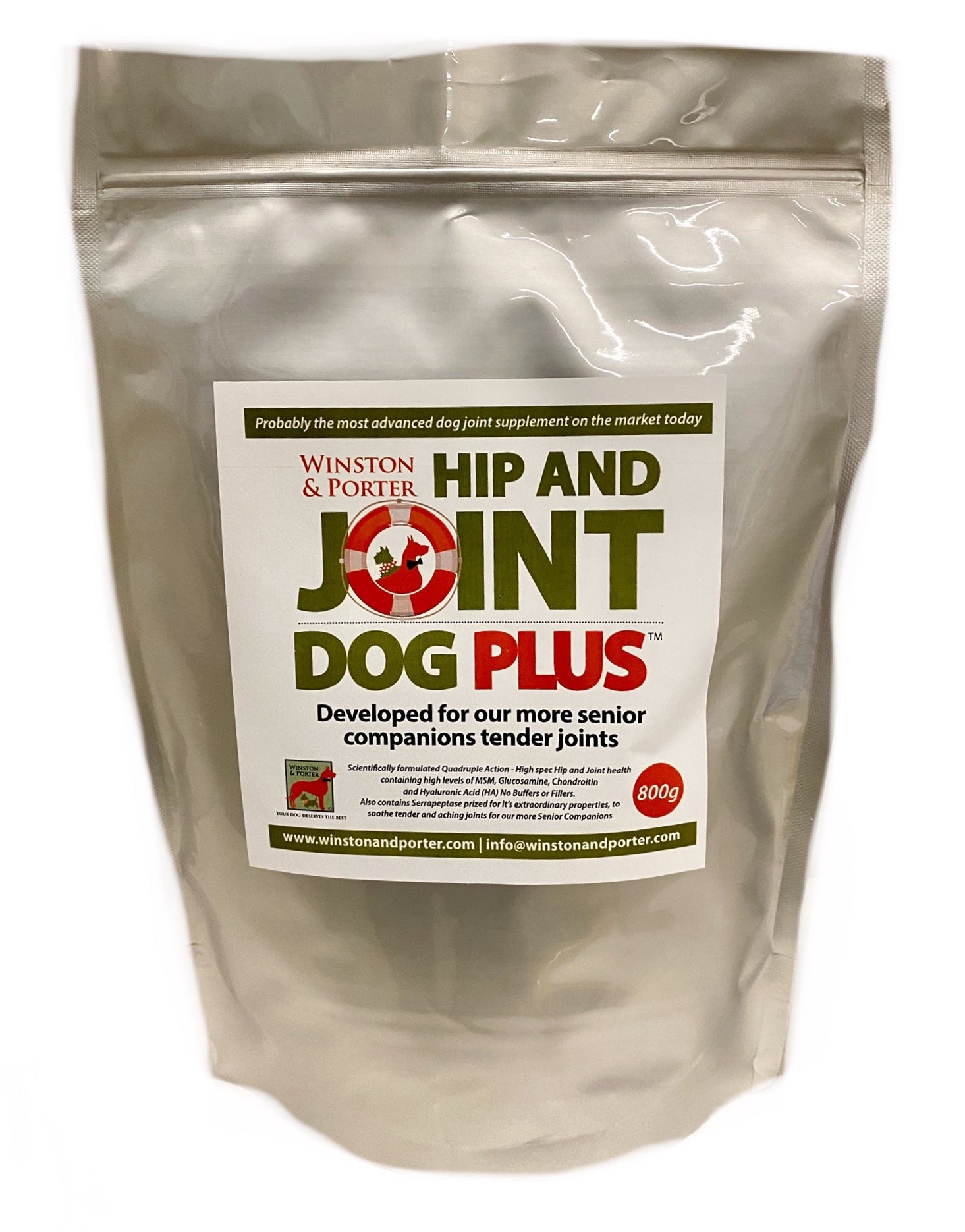
Hip & Joint Dog and Hip & Joint Dog PLUS are fine powders that mix into your dog's usual food, which suits dogs who take their meals without fuss. For dogs that will not finish a bowl with powder stirred through, a chew or liquid format may be worth discussing with your vet before giving up on joint support altogether.
Watch out: a dog that licks the powder off the top of the food and leaves the rest is not getting the full serving, so mix it through thoroughly rather than sprinkling it on top.
Reading the Ingredients Behind the Taste
Taste and texture are influenced by the ingredients, and an ingredient list alone cannot tell you how a dog will react. What it can show is how much of each active ingredient is in a serving. A supplement that hides its amounts behind a proprietary blend makes it hard to judge value or compare products fairly.
Hip & Joint Dog PLUS lists its contents per medium-dog daily serving of 6.5g: 2,500mg MSM, 2,500mg glucosamine HCl, 1,200mg chondroitin sulphate, 300mg hyaluronic acid, plus serrapeptase. Readers can check these figures against any other product they are considering. Our full explanation of why we disclose exact amounts is in our guide to [why proprietary blends are bad supplements | winstonandporter.com].
How to Give a Dog Joint Supplement Without a Fight
Getting a supplement into a dog once is easy. Getting it in every day for months is the part that decides whether joint support actually happens, and it is the part most reviews ignore.

Start with a small amount mixed into a food your dog already enjoys. Many dogs accept a new smell more easily when it is mixed into something familiar, and a small starting amount lets you see how they react. Build up to the full recommended daily amount over a few days if your dog is wary. Give it at the same time each day, and mix it in thoroughly so the powder is not left at the bottom of the bowl.
Acceptance is not fixed. A dog may take a supplement happily for a week and then refuse it, often because the novelty has worn off or because the smell has become associated with something unpleasant. If refusal starts after a few days, try a different food base before assuming the format is wrong. If your dog takes medication, is injured or has an ongoing health condition, check with your vet before you start.
Dog characteristics change the picture. Small dogs need a smaller serving than medium or large dogs. Dogs on a prescription diet may need the supplement checked against their diet's restrictions before mixing.
Long-term adherence is the real test. Keep a simple note of how readily your dog eats it each day, because that record will tell you more than any star rating. Joint supplements take time to show any effect, so give the supplement at least a month before judging it, but if refusal continues past that point, speak to your vet about other options rather than persisting with a format your dog will not take.
How to Judge a Palatability Review Before You Trust It
Start by checking whether the review explains its method. A trustworthy review should say how many dogs were tested, what format was offered, whether the testing was done by the reviewer or taken from owners, and whether the reviewer received the product for free.
Look for conflicts of interest. If a review is written by the brand it praises, or if the site earns money from affiliate links, read the result with caution. A review that describes its own limits on hands-on testing is a useful sign of transparency, because it states clearly what it did and did not test.
Finally, separate taste claims from health claims. A dog that enjoys a supplement is a good sign, but it does not prove the product helps joints. Check whether the review cites evidence for both.
Before relying on a palatability review, check how it was conducted and who stands to gain from it:
| Check | What to look for | Why it matters |
|---|---|---|
| Sample size | How many dogs were tested | A single dog's preference is not a reliable result |
| Method | Whether the reviewer tested hands-on or relied on owner reports | Shows how the result was actually obtained |
| Format offered | Whether the product was plain, mixed in food, or given as a treat | Changes what 'acceptance' means |
| Conflicts of interest | Brand authorship, affiliate links, or free product | Can bias the verdict |
| Taste vs health claims | Whether efficacy is backed by separate evidence | A dog enjoying a supplement does not prove it helps joints |
Choosing a Format Your Dog Will Actually Eat
The best format is the one your dog will eat every day. If your dog happily takes meals with mix-ins, a powder like [Hip and Joint Dog PLUS - Dog Joint Supplement | winstonandporter.com] may suit you, since it mixes into food without a separate treat. A joint-support porridge such as [Max Strength - Dog Joint Supplement Porridge | winstonandporter.com] combines joint nutrients with a full multivitamin and mineral blend, which some owners prefer for all-round daily feeding.
Try one format for at least a month before deciding. Keep a simple note of how readily your dog eats it, because that record will tell you more than any star rating. If refusal continues, speak to your vet about other options.
Hip & Joint Dog, Hip & Joint Dog PLUS, Max Strength and Max Strength Plus are made in the UK, and their listings state the amount of each active ingredient, so you can compare what your dog is receiving.
Ready to find a supplement your dog will actually take? Explore the Winston & Porter range and choose the format that fits your dog's routine. Register to get started.
Frequently Asked Questions
How can I tell if my dog will like a joint supplement?
Start with a small amount mixed into food your dog already enjoys, then watch whether they eat it readily over several days. Palatability varies by dog, so one dog's enthusiasm tells you little about another's. Many owners also find that dogs wary of anything new accept a supplement more easily when it is introduced gradually and mixed into a familiar meal. If a dog consistently refuses, changing the format, such as moving from powder to chews, is often more practical than forcing the original product.
Are powder or chewable joint supplements easier for dogs to eat?
Neither format is universally easier. Powders mix into wet or dry food and suit dogs who dislike chewing, but some dogs notice the texture or smell. Chews feel like a treat to many dogs, though flavourings and binders take up space that could otherwise hold joint nutrients. Hip & Joint Dog and Hip & Joint Dog PLUS are fine powders that mix into normal food, while the supplement format you choose should match how your dog eats. Try a small trial before committing to a full pouch.
Can I mix a dog joint supplement with food?
Yes. Hip & Joint Dog and Hip & Joint Dog PLUS are designed to be sprinkled onto your dog's food once a day and mixed in. Max Strength can be mixed with warm water to make a porridge, stirred into wet food, or sprinkled over wet or dry food. Use the scoop included with each order and follow the feeding table for your dog's size, and check with your vet if your dog takes medication or has an ongoing health condition.
What should I look for in a dog joint supplement review?
Look for reviews that describe how the dog responded to the taste and texture, and whether the reviewer followed a set feeding routine. Be cautious of reviews that only praise the product's effectiveness without mentioning acceptance, as clinical results and palatability are separate questions. Check whether the reviewer has any connection to the brand, and whether the review explains its methods. Owner ratings are useful for palatability but do not prove that a supplement works.

Leave a comment