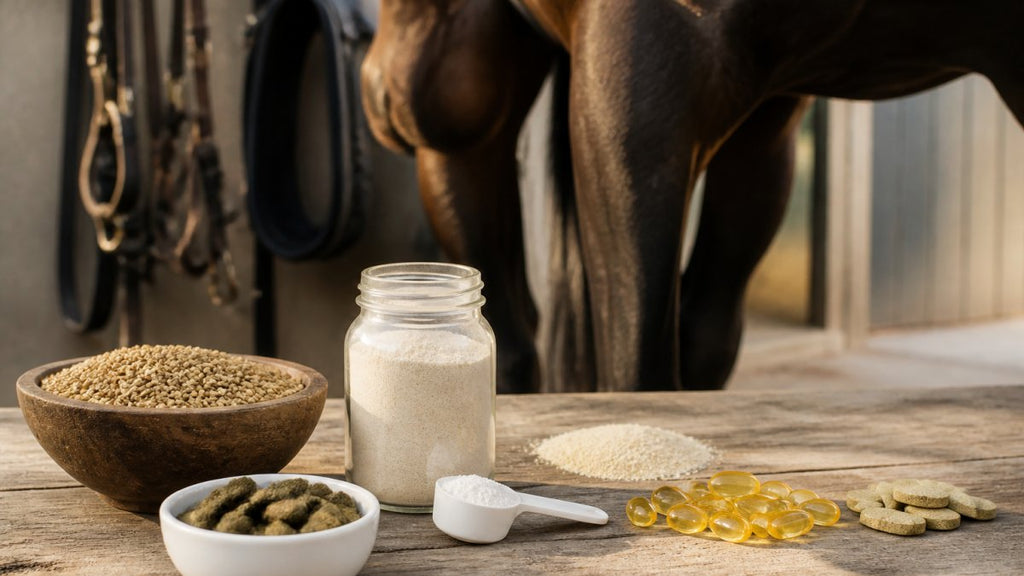
Are Equine Joint Supplements for Competition Worth It?
Last Updated: October 28, 2026
Quick Summary
The best equine joint supplements for competition combine research-backed ingredients at meaningful daily doses, contain nothing on the FEI Prohibited Substance List, and offer transparent cost per serving. For a horse in full competition work, choose a full-strength formula with glucosamine, MSM, chondroitin and hyaluronic acid, and always verify competition compliance in writing before feeding.
- A 2020 study found supplemented horses showed increased hock range of motion at the walk.
- Hip & Joint Horse PLUS delivers 16,438 mg of glucosamine HCl per 35 ml scoop.
- Allow four to eight weeks of consistent daily feeding before judging a joint supplement.
- Ask suppliers for a written product declaration confirming no prohibited substances.
- Glucose-free formulas suit laminitic or Cushing's-prone horses while keeping MSM, chondroitin and HA at full strength.
Table of Contents
- What Makes a Joint Supplement Suitable for a Competition Horse?
- Equine Joint Supplement Ingredients That Actually Matter
- Comparison Table: Winston & Porter Equine Joint Supplements
- Equine Joint Supplement Competition Rules and Banned Substances
- How Long Do Horse Joint Supplements Take to Work?
- Choosing the Right Formula for Your Horse's Age and Workload
- Start Your Horse on a Competition-Ready Joint Plan
- Frequently Asked Questions
What Makes a Joint Supplement Suitable for a Competition Horse?
A competition-ready joint supplement must do three things at once: supply research-backed ingredients at meaningful daily doses, contain nothing on the FEI Prohibited Substance List, and fit a training schedule that leaves no room for guesswork. A hard-working horse asks more of its joints than a field companion ever will.
The stakes are higher than most owners realise. A 2020 study published in PubMed Central's evaluation of an oral joint supplement found that supplemented horses showed increased hock range of motion at the walk, with a similar trend at the trot, compared with controls. That is measurable movement, not marketing.
Suitability comes down to four checks:
- Ingredient quality and purity: human-grade ingredients
- Daily dose transparency: grams per serving, not a proprietary blend
- Competition compliance: no prohibited substances, with documentation to prove it
- Value per serving: cost per day at the recommended feeding rate
Equine Joint Supplement Ingredients That Actually Matter
UC Davis Centre for Equine Health's survey on joint supplementation reports that 84% of respondents gave supplements to at least one horse, and 90% of those users said they would use supplements to treat or prevent joint issues. Owners clearly believe in them. The question is whether the formula earns that belief.
Glucosamine for Horses: The Core Cartilage Building Block
Glucosamine for horses is an amino sugar that forms a building block of the cartilage matrix, and it is one of the most researched joint nutrients available. Our Hip & Joint Horse PLUS delivers 16,438 mg of glucosamine HCl per 35 ml scoop, a dose built for horses in genuine work rather than maintenance.

MSM, Chondroitin and Hyaluronic Acid: Comfort and Lubrication
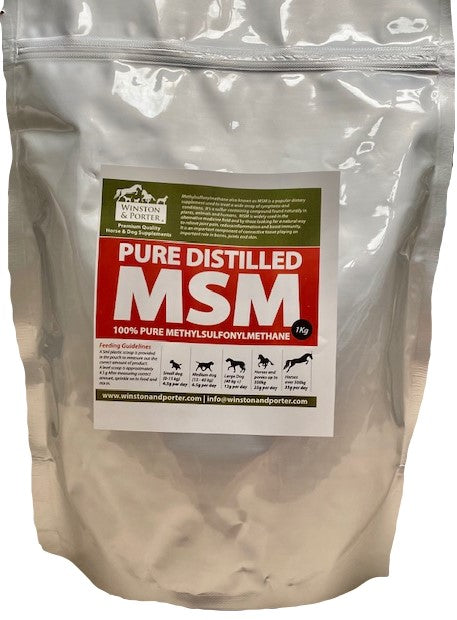
MSM supports flexibility and eases stiffness, chondroitin helps maintain healthy cartilage, and hyaluronic acid lubricates the joint for smoother movement. Our formulas pair 13,698 mg of MSM with 4,109 mg of chondroitin sulphate and 411 mg of hyaluronic acid per scoop. If you want to add a single ingredient to an existing plan, our pure distilled MSM for horses and ponies is 99.9% pure and easy to top-dress.

Comparison Table: Winston & Porter Equine Joint Supplements
| Product | Price | Key Actives per Scoop | Best For |
|---|---|---|---|
| Hip & Joint Horse PLUS | £35.95 | Glucosamine 16,438 mg, MSM 13,698 mg, chondroitin 4,109 mg, HA 411 mg, serrapeptase | Competition and hard-working horses |
| Hip & Joint Horse PLUS Glucose Free | £31.95 | MSM 13,698 mg, chondroitin 4,109 mg, HA 411 mg, serrapeptase | Laminitic or Cushing's-prone horses |
| Hip & Joint Horse Premium | £27.95 | Glucosamine 16,438 mg, MSM 13,698 mg, chondroitin 4,109 mg, HA 411 mg | Everyday maintenance and older horses |
| Hip & Joint Horse Glucose Free Premium | £24.95 | MSM 13,698 mg, chondroitin 4,109 mg, HA 411 mg | Budget-conscious metabolic care |
| Glucosamine HCl Equine Support | £24.95 | 99% pure glucosamine HCl | Foundational single-ingredient support |
| Pure MSM for Horses & Ponies | £51.40 | 99.9% pure distilled MSM | Adding sulphur support to an existing plan |
You can browse the full horse joint supplement range to see every option side by side.
Our verdict: for a horse in full competition work, Hip & Joint Horse PLUS is the pick. The glucose-free version matches it minus the glucosamine, which matters if your vet has flagged sugar sensitivity.
Equine Joint Supplement Competition Rules and Banned Substances
Competition legality is the question that should come before price, and it is the one most buying guides skip. The product listings for Hip & Joint Horse PLUS and Hip and Joint Horse Premium state that their ingredients are natural and contain no prohibited substances. That is a claim you should always ask a supplier to document, not simply accept.
The rules themselves sit with the governing bodies. FEI's clean sport and prohibited substances guidance sets out what competing horses may and may not be given, and national bodies apply their own medication controls on top. Check your discipline's current rules before introducing anything new, and keep the product label and batch details on file.
How to verify a supplement before you feed it
A label that says "natural" tells you nothing about competition safety. Work through these checks in order:
Hip & Joint Horse PLUS | Winston & Porter →
- Confirm the current prohibited list. Check the version in force for your discipline and your horse's registration category, not a screenshot saved from last season.
- Ask for a product declaration. A reputable supplier should be able to state, in writing, that the product contains no substances on the current prohibited list and identify the batch. If a supplier cannot answer this, treat that as your answer.
- Ask about batch testing and contamination controls. Herbal and botanical ingredients carry a small but real risk of cross-contamination during manufacture. Ask whether finished batches are screened and whether the manufacturing site handles prohibited substances.
- Keep a paper trail. Store the label, batch number and any declaration with your horse's records. If a medication-control question arises, documentation is what protects you.
Watch Out
A "natural" label does not guarantee competition safety. Turmeric and MSM are both natural, yet their status depends on the product and the rules in force, so verify before you feed, and never assume a supplement is exempt because it is sold without a prescription.
Where our range stands
If your horse is laminitic or Cushing's-prone, our glucose-free horse joint supplement removes added sugar from the equation while keeping MSM, chondroitin and hyaluronic acid at full strength.

How Long Do Horse Joint Supplements Take to Work?
Most owners should allow four to eight weeks of consistent daily feeding before judging a joint supplement. Cartilage and synovial fluid change slowly, and short trials tell you very little. But "wait and see" is not a plan, the owners who get the most from supplementation are the ones who measure something specific.
Set a baseline before you start
- Warm-up stiffness: how many minutes before your horse loosens up at the start of a session
- Willingness to stretch: how readily your horse extends a foreleg for the farrier or picks up a hind for grooming
- Movement quality on the lunge: whether the trot is free and forward or short and guarded
- Recovery after work: how quickly your horse settles after exercise
A realistic trial timeline
- Week 0: record your baseline markers and confirm your horse is sound enough to trial a supplement. If there is heat, swelling or lameness, speak to your vet first, a supplement is not a diagnosis.
- Weeks 1-4: feed the loading dose if the label offers one, then move to the daily rate. Do not change anything else in the diet or workload during this window if you can avoid it.
- Weeks 4-8: reassess against your written baseline, not against how your horse felt last week. Look for consistent change across more than one marker.
- Week 8 onward: if you see improvement, drop to the maintenance rate and keep monitoring. If you see nothing, stop and speak to your vet rather than doubling the dose.
What to expect from different ingredients
Response time varies by what you are feeding. Glucosamine and chondroitin support the cartilage matrix and tend to show their effects gradually over weeks rather than days. MSM is often noticed sooner by owners watching for stiffness after stabling. Hyaluronic acid contributes to joint lubrication and is typically assessed through movement quality rather than a single obvious change. This is why a combined formula is judged as a whole over a full trial, not ingredient by ingredient.
When to stop and call the vet
A supplement is support, not treatment. Stop the trial and seek veterinary advice if your horse becomes lame, develops heat or swelling in a joint, or shows a sudden change in attitude or appetite. Equally, if eight weeks of consistent feeding produces no change across your markers, the honest answer is that this formula is not the right one for this horse, not that you need a bigger scoop.
Choosing the Right Formula for Your Horse's Age and Workload
- Competition and hard work: full-strength glucosamine, MSM, chondroitin and hyaluronic acid, fed daily without gaps
- Ageing horse: the same core ingredients at maintenance rate, with comfort as the priority
- Metabolic sensitivity: glucose-free formulas across the board
- Young or resting horse: single-ingredient support such as glucosamine HCl is often enough
Our guide to the best horse joint supplements walks through these decisions in more detail if you are still weighing options.
Start Your Horse on a Competition-Ready Joint Plan
Winston & Porter develops scientifically developed formulas with human-grade ingredients. Hundreds of five-star reviews across Trustpilot, Google and Lipscore reflect customer feedback.
Get started with Winston & Porter.
Frequently Asked Questions
Which ingredients should I look for in a competition horse joint supplement?
Look for a formula that states exact daily doses rather than a proprietary blend. Winston & Porter's Hip & Joint Horse PLUS lists 16,438 mg of glucosamine HCl, 13,698 mg of MSM, 4,109 mg of chondroitin sulphate and 411 mg of hyaluronic acid per 35 ml scoop.
Are equine joint supplements permitted under competition rules?
The product listings for Hip & Joint Horse PLUS and Hip and Joint Horse Premium state that their ingredients are natural and contain no prohibited substances. Check competition requirements with your governing body.
How long should a horse take a joint supplement before you assess its effects?
The product listings for Hip & Joint Horse PLUS and Hip and Joint Horse Premium describe an optional loading dose of two scoops daily for the first seven days and a daily dose of one 35 ml scoop per 500 kg horse.
Is glucosamine effective for horses?
The Glucosamine HCl Equine Joint Support listing describes glucosamine as an amino sugar that forms a building block for the cartilage matrix. Hip & Joint Horse PLUS lists 16,438 mg of glucosamine HCl per 35 ml scoop.
Can I combine a joint supplement with other products safely?
The Pure MSM for Horses & Ponies listing advises discontinuing use and seeking veterinary advice if a horse becomes unwell after taking the supplement.

Blogtastic Articles

26
Oct

26
Oct